

Publication
- Engineering Silkworm Silk for Mechanically and Biologically Compliant Skin Electronics
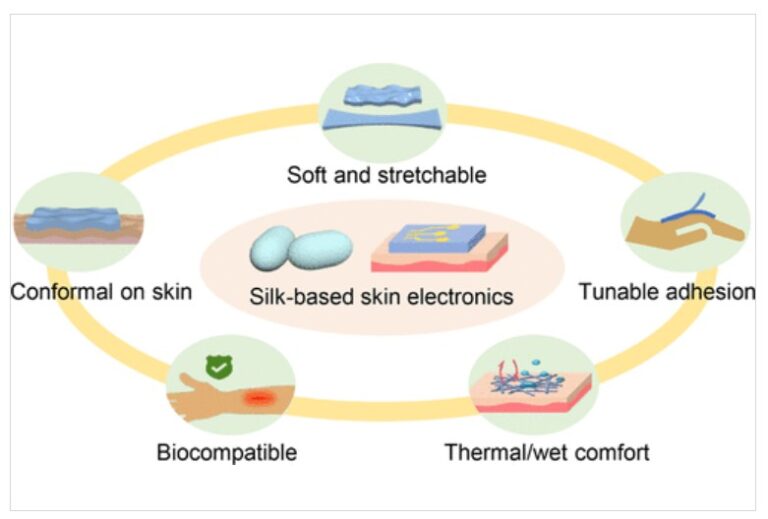
kin electronics integrated with the human body have attracted significant global interest due to their potential applications in healthcare monitoring and motion sensing. Over the past few decades, electronic devices have become increasingly soft and stretchable with the progress of engineering and materials science, aiming to achieve enhanced integration with the skin and improved acquisition of physiological signals. However, owing to the delicate nature of human skin and its intricate role in regulating body temperature and fluid balance, electronic devices at the skin interface must not only exhibit mechanical compliance but also ensure physiological comfort. They should not block skin metabolism or cause skin damage during daily or long-term use. As a result, the materials used should be biocompatible with the skin/organs without leading to allergic reactions or inflammatory responses. Additionally, these materials should be readily processed into various formats to accommodate skin deformation and breath. As a natural biomaterial, silk is widely acknowledged as the ideal material for developing skin-friendly electronics due to its multifaceted benefits in comparison with many synthetic polymers, including good biocompatibility, tailorable biodegradability, and versatile processability. These properties, which are linked to the conformation of silk, grant silk materials the capacity to be programmed as soft and stretchable as skin.
Furthermore, silk can be processed through various manufacturing techniques, resulting in diverse material formats like fibers, mats, thin films, hydrogels, and scaffolds that are readily attainable. These rich silk formats exhibit diverse properties and performance characteristics, making them suitable for meeting various requirements in both in vivo and in vitro applications. Leveraging these attributes, natural and regenerated silk materials have been successfully employed in skin-integrated electronics, including but not limited to textile electronics, transient biosensors, adhesive ionic gels, conformal/breathable/stretchable electrodes, and smart dressings. These electronic devices show a high degree of geometric and mechanical compatibility with the skin, and more importantly, they do not cause physical discomfort or disturb skin functions, providing novel prospects for developing high-performance and biologically compliant skin electronics.
In this Account, we highlight recent progress of silk-based materials for skin electronics that prioritize both mechanical and biological compliance. We begin with a comprehensive exploration of the hierarchical structures and inherent properties of natural silk fibers, showing the biocompatibility and biodegradability of silk adapted for bioelectronics, as well as the solution-processability facilitated for the creation of silk materials with versatile formats and properties. Subsequently, we systematically discuss the design and functionality of silk-based skin electronics through engineering structures and materials to fulfill the requirements of high mechanical and biological compliance with the skin. Finally, we elucidate the limitations of current silk-based skin electronics and briefly envision the future challenges and prospects for developing silk as high-performance electronics for comfortable wearing systems.
Researcher/Author:
Qingsong Li, Shaobo Ji, Guanglin Li, Zhiyuan Liu, Xiaodong Chen
Published in: ACS Publications (20 August 2025)
To download the paper, please proceed to:
DOI: https://doi.org/10.1021/accountsmr.5c00114
- Home
- Engineering Silkworm Silk for Mechanically and Biologically Compliant Skin Electronics
Singapore Hybrid-Integrated Next-Generation μ-Electronics (SHINE) Centre
- Block E6, #E6-5-3, 5 Engineering Drive 1, Singapore 117608
- +65 6601 8522
- shine@nus.edu.sg