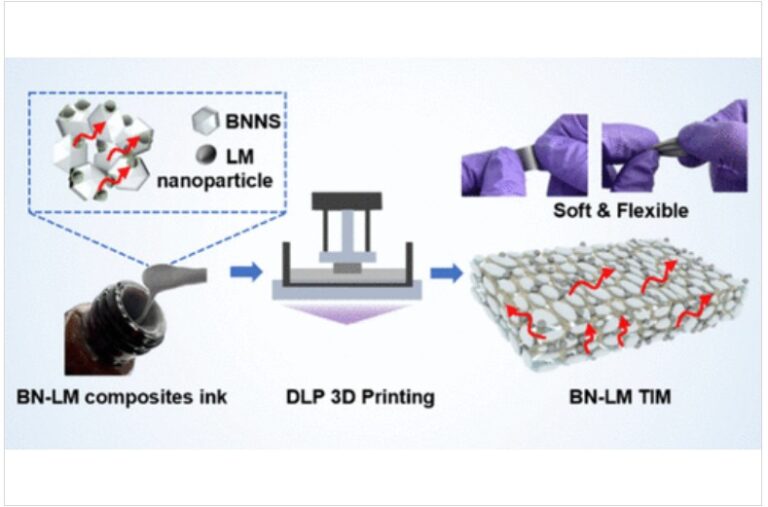
Efficient thermal management and mechanical flexibility are crucial for modern electronic devices, where compact designs and high power densities generate substantial heat, demanding materials with both high efficiency and excellent conformability. Herein, a hybrid thermal interface material (TIM) exhibiting high thermal conductivity is developed by integrating two-dimensional boron nitride nanosheets (BNNS) and liquid metal (LM) nanoparticles as thermally conductive fillers into a photocurable polydimethylsiloxane (PDMS) matrix. Interfacial engineering of the fillers promotes uniform dispersion and forms a continuous thermal network, enhancing heat transfer while preserving softness. Compared to conventional BN-based 3D-printable TIMs, this hybrid system offers high thermal conductivity and an ultralow Young’s modulus (0.07 MPa), enabling superior conformability on complex surfaces and minimizing thermal contact resistance. The composite also maintains excellent electrical insulation and mechanical stability under repeated deformation, ensuring long-term reliability. Demonstrated in LEDs, batteries, and flexible thermoelectric devices, the BN-LM TIM significantly improves heat dissipation and device performance. This work offers a new strategy that combines optimized filler interactions with DLP 3D printing, bridging efficient heat transport with structural adaptability to advance thermal management in next-generation flexible electronics.
Researcher/Author:
Yixuan Jiang, Hyunwoo Bark, Peiwen Huang, Tan Hu, Yun Li, Pooi See Lee