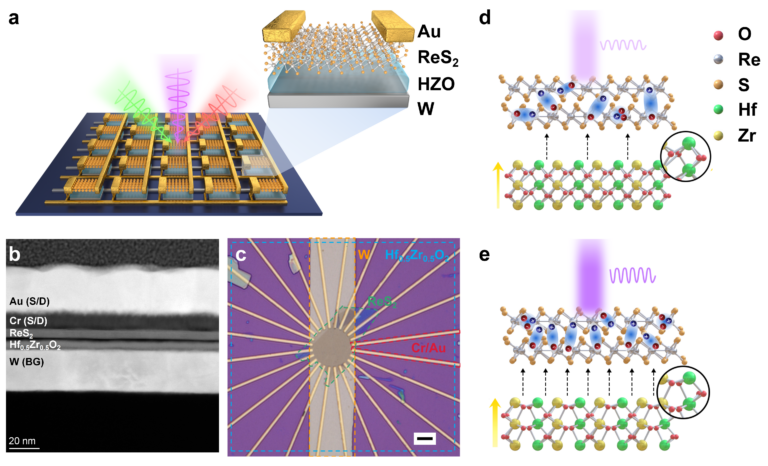
The integration of light polarization into non-volatile memory enables angle-resolved information processing, unlocking new photonic channels for communication, computation and imaging. Yet practical polarization-sensitive memory remains rare. Here, we report a 2D rhenium disulfide (ReS2)/hafnium zirconium oxide (Hf0.5Zr0.5O2, HZO) ferroelectric field-effect transistor in which field-driven charge separation realizes polarization-resolved memory.
The redistribution of photo-generated carriers at the heterostructure interface establishes an interfacial electrostatic field that modulates HZO ferroelectric domains and encodes non-volatile states. We also find that interfacial compressive stress induced by lattice mismatch shortens the Re-Re bond, which enhances the Re-Re chain anisotropy by 3.7x (from 2.67 to 9.98). Integrated into arrays for photonic neural networks, the device attains >93% accuracy on a transformer model. Leveraging the cumulative switching property of HZO with sequential optical signals, the device enables in-situ multiplication and accumulation of inputs over time, achieving 4x area saving with <1% accuracy loss.
Beyond amplitude and phase, the demonstrated electro-optic device enables optical polarization as an additional information read-out, which significantly increases the information density of photonic-based computing.
Researcher/Author:
Lead Principal Investigator – Prof Aaron Voon-Yew Thean
Researchers – Quanzhen Wan, Shi Zhao, Baoshan Tang, Zhi Gen Yu, Zihang Fang, Jin Feng Leong, Zefeng Xu, Yong-Wei Zhang, Evgeny Zamburg