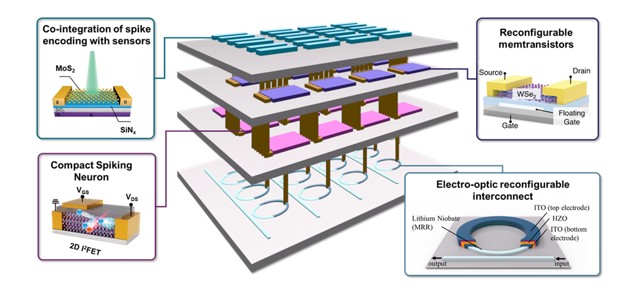
The increasing demand for intelligent, real-time processing is driving artificial intelligence beyond centralized data centers toward distributed, edge-based applications, including autonomous robotics, mobile platforms, and Internet-of-Things (IoT) sensors. However, the energy consumption and form-factor constraints of conventional AI hardware—such as graphics processing units (GPUs) and AI-specific application-specific integrated circuits (ASICs)—pose significant challenges for deployment in resource-limited edge environments. Bioinspired computing paradigms offer a compelling alternative by emulating the efficiency, adaptability, and parallelism of biological neural systems to enable low-power, real-time intelligence. Among these approaches, spiking neural networks (SNNs) are particularly attractive due to their sparse, event-driven operation and have demonstrated orders-of-magnitude improvements in energy efficiency on neuromorphic platforms such as SpiNNaker and Intel’s Loihi. Nevertheless, fully realizing the potential of bioinspired intelligence at the edge necessitates a new class of specialized hardware. Recent advances in materials science, especially the integration of two-dimensional (2D) materials, provide opportunities to develop compact, reconfigurable neuromorphic devices capable of emulating complex neuronal dynamics at ultra-low power. Together, these innovations pave the way for scalable, multifunctional edge AI systems with enhanced capabilities for perception, adaptation, and autonomous decision-making, representing a transformative step toward energy-efficient computing for pervasive intelligent technologies.
Researcher/Author:
Jin Feng Leong, Maheswari Sivan, Jieming Pan, Zihang Fang, Jianan Li, Zefeng Xu, Shi Zhao, Quanzhen Wan, Evgeny Zamburg, Aaron Voon-Yew Thean
Published in: : Small (2025): e06638 (30 October 2025)
To download the paper, please proceed to:
DOI: https://doi-org/10.1002/smll.202506638