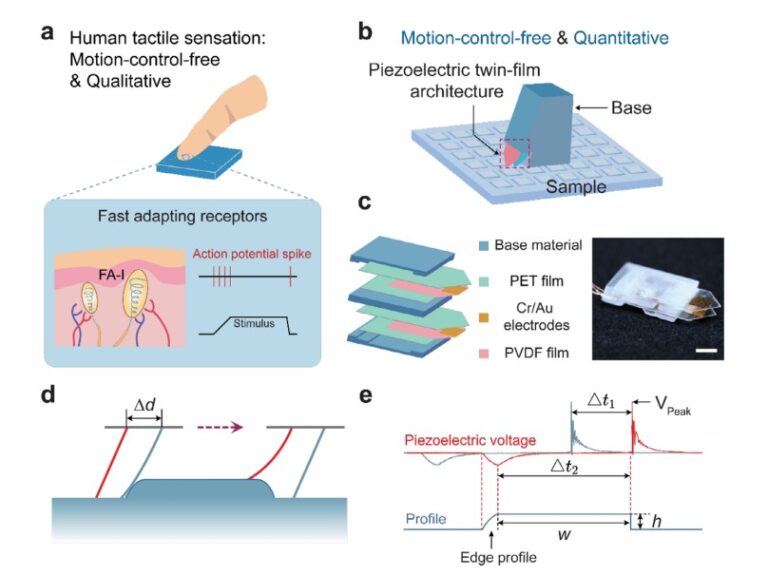
Tactile sensors enabling human-like behavior to identify surface microstructures are essential for humanoid robots to interact precisely with complex environments. Most existing approaches use materials responding to dynamic forces and rely on machine learning methods to distinguish various types of surface microstructures. Quantitatively profiling the surface microstructures is significant but challenging, especially under the requirement of eliminating external bulky motion-control systems. Here, a quantitative tactile surface profiling strategy is presented through time-domain analysis of the signal of a piezoelectric twin-film architecture. The architecture uses two parallel piezoelectric films with a fixed interlayer distance, generating twin voltage signals with a time delay, which is inversely proportional to the scanning speed, and consequently removes the need for motion control. The microstructure heights correlate with the peak voltages, whereas widths and edge profiles are derived from the temporal analysis of distinct signal features. Tactile and in situ measurement of surface microstructures is demonstrated with high accuracy (>99.2%) over a broad height range of 1–1000 µm. Furthermore, in-line quality inspection during additive manufacturing is realized by quantitatively profiling the surface microstructures. This work will drive innovations in tactile technologies that emulate and potentially surpass human capabilities and advance in situ surface characterization methods.