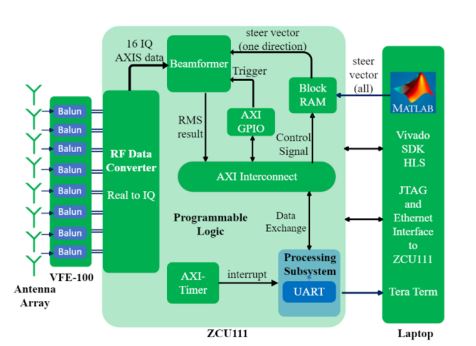
LCMV beamforming for an L-band antenna array using the Xilinx RFSoC is presented. Implementation of the fully digital beamformer is discussed, including details of the implementation in hardware, High Level Synthesis (HLS), and software. The beamformer is demonstrated for several LCMV cases using an L-band array with eight elements.
Negative-U Defect Passivation in Oxide-Semiconductor by Channel Defect Self-Compensation Effect to achieve Low Bias Stress VTH Instability of Low-Thermal Budget IGZO TFT and FeFETs December 13, 2023
Publication
Negative-U Defect Passivation in Oxide-Semiconductor by Channel Defect Self-Compensation Effect to achieve Low Bias Stress VTH Instability of Low-Thermal Budget IGZO TFT and FeFETs
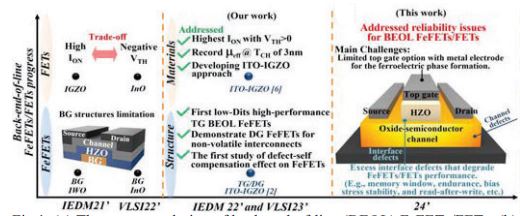
In this work, we elucidate the fundamental bias stress reliability mechanism in oxide-semiconductor devices and provided guidelines to improve interface/bulk-induced V TH degradation. We provide further insights into the defect-self compensation effect for the bilayer ITO-IGZO channel. Specifically, how our process approach led to effective passivation of channel defects such as negative-U defects, and ionized-oxygen-vacancy defects. With bilayer ITO-IGZO, we demonstrated 10x negative/positive bias stress (NBS/PBS), and 4x negative bias illumination stress (NBIS) improvement against the conventional mono-IGZO devices. Furthermore, under a low-thermal budget constraint, we implemented a sacrificial replacement gate stress memorization technique to enhance the ferroelectric phase to enable a double-gated (DG) IGZO FeFET. Our reliability-optimized DG ITO-IGZO FeFETs exhibit an enhanced memory window (MW) of 1.7V, excellent memory-write endurance of 10 7 cycles, outstanding memory retention with high I ON /I OFF of 10 6 after 10 4 s, record-low NBS/PNS V TH shift of 30mV, and NBIS V TH shift of 110mV after stress time of 1000s. These devices set a new oxide thin-film transistor (TFT) reliability record making major strides toward highly reliable BEOL logic and memory switches.
Researcher/Author:
Chun-Kuei Chen, Zefeng Xu, Sonu Hooda, Jieming Pan, Evgeny Zamburg, and Aaron Voon-Yew Thean
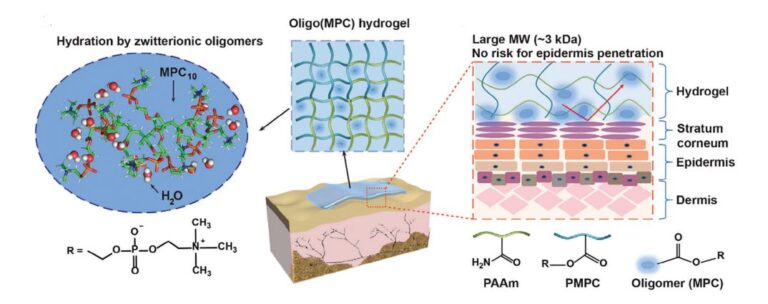
Hydrogels are ideal interfacing materials for on-skin healthcare devices, yet their susceptibility to dehydration hinders their practical use. While incorporating hygroscopic metal salts can prevent dehydration and maintain ionic conductivity, concerns arise regarding metal toxicity due to the passage of small ions through the skin barrier. Herein, an antidehydration hydrogel enabled by the incorporation of zwitterionic oligomers into its network is reported. This hydrogel exhibits exceptional water retention properties, maintaining ≈88% of its weight at 40% relative humidity, 25 °C for 50 days and about 84% after being heated at 50 °C for 3 h. Crucially, the molecular weight design of the embedded oligomers prevents their penetration into the epidermis, as evidenced by experimental and molecular simulation results. The hydrogel allows stable signal acquisition in electrophysiological monitoring of humans and plants under low-humidity conditions. This research provides a promising strategy for the development of epidermis-safe and biocompatible antidehydration hydrogel interfaces for on-skin devices.
Researcher/Author:
Ke He, Pingqiang Cai, Shaobo Ji, Zihan Tang, Zhou Fang, Wenlong Li, Jing Yu, Jiangtao Su, Yifei Luo, Feilong Zhang, Ting Wang, Ming Wang, Changjin Wan, Liang Pan, Baohua Ji, Dechang Li, and Xiaodong Chen
Dr. Mohammad Ameen received B.Tech and M.Tech degrees in Electronics and Communication Engineering from Mahatma Gandhi University, Kottayam, India, in 2012 and 2014 respectively, and PhD degree from the Indian Institute of Technology (IIT) Dhanbad in 2022. He is currently working as a Research Fellow at the Department of Electrical and Computer Engineering, National University of Singapore. He received the Young Scientist Award (YSA) at the Union Radio Science General Assembly and Scientific Symposium (URSI GASS-2020), during 29th August to 5th September 2020, held at Rome, Italy. Also, he received the Young Scientist Award at the URSI combined Atlantic/Asia-Pacific Radio Science Conference (URSI AT-AP-RASC 2022), during May 29 to June 3, 2022, at Gran Canaria, Spain. His research interests include the design and development of antenna arrays, conformal antennas, deployable antennas, stretchable antennas, foldable antennas, conformal phased array antennas, circularly polarized metamaterial/metasurface antennas, multiple-input-multiple-output (MIMO) antennas, high-impedance surfaces.
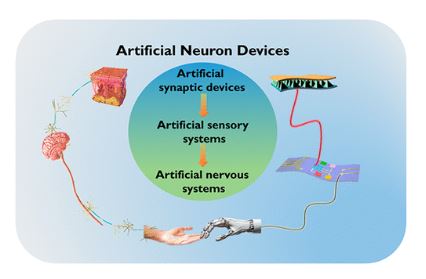
Efforts to design devices emulating complex cognitive abilities and response processes of biological systems have long been a coveted goal. Recent advancements in flexible electronics, mirroring human tissue’s mechanical properties, hold significant promise. Artificial neuron devices, hinging on flexible artificial synapses, bioinspired sensors, and actuators, are meticulously engineered to mimic the biological systems. However, this field is in its infancy, requiring substantial groundwork to achieve autonomous systems with intelligent feedback, adaptability, and tangible problem-solving capabilities. This review provides a comprehensive overview of recent advancements in artificial neuron devices. It starts with fundamental principles of artificial synaptic devices and explores artificial sensory systems, integrating artificial synapses and bioinspired sensors to replicate all five human senses. A systematic presentation of artificial nervous systems follows, designed to emulate fundamental human nervous system functions. The review also discusses potential applications and outlines existing challenges, offering insights into future prospects. We aim for this review to illuminate the burgeoning field of artificial neuron devices, inspiring further innovation in this captivating area of research.
Researcher/Author:
Ke He, Cong Wang, Yongli He, Jiangtao Su & Xiaodong Chen
Published in:
Chemical Reviews 2023, 123, 23, 13796-13865 (Review)
Dr. Rakesh TIRUPATHI (Member, IEEE) received his B.Tech. in Electronics and Communication Engineering from Bapatla Engineering College, India, in 2010. He went on to complete his M.Tech. and Ph.D. in Electronics and Communication Engineering at the National Institute of Technology (NIT) Rourkela, India, in 2012 and 2021, respectively.
He is currently a Research Fellow in the Department of Electrical and Computer Engineering at the National University of Singapore (NUS), working in the research group of Prof. Aaron Thean. Prior to this, he held positions as Scientist-C at the Indian Institute of Technology (IIT) Delhi and as a Research Associate at IIT Hyderabad.
Dr. Tirupathi’s research interests lie at the intersection of electronics, photonics, and computing. His expertise includes analog and digital integrated circuit design, sensor interfacing circuits, and photonic chip design, with a focus on enabling emerging technologies in these domains.
Dr. Sonu Devi is a research fellow and project leader in Aaron Thean’s Research group at National University of Singapore. Dr. Sonu is a materials science researcher with a focus on the development of novel materials for semiconductor device and related applications.
Dr. Sonu completed her PhD in Physics in 2016 from IUAC Delhi. Her research mainly focussed on ion beam induced defect creation and recovery in semiconductor materials.
After PhD, Dr. Sonu joined NUSNNI Nanocore, National University of Singapore in 2017, where she worked on growth of crystalline oxide thin films using pulsed laser deposition and their transfer on Si substrate for CMOS compatibility. In 2020, Dr. Sonu joined Prof. Aaron Thean’s group at the Department of Electrical and Computer Engineering, National University of Singapore. Here, her research interests include fabrication of back-end-of-line compatible, advance semiconductor devices for 3-D monolithic integration. Her work has been accepted in leading technology conferences like VLSI, IEDM and EDTM.
Mr Leong Jin Feng has a Bachelor in Science (Physics) with Honours from the National University of Singapore (NUS). He was awarded the Kent Ridge Undergraduate Scholarship for his undergraduate studies and he was also admitted into the Special Programme in Science, which aims to develop young undergraduate researchers in integrated science research. In this programme, he has undertook research with a scientist from the Centre of Climate Research Singapore on understanding the Sumatra Squall Line phenomenon with the help of weather simulations.
He has also spent two years with Professor Sow Chorng Haur from the Department of Physics in NUS, both as a Final Year Project student and a research assistant. During this period, he was involved in the study of defects and its effects on the optical properties of a two-dimensional material, Tungsten disulfide. In addition, he has also investigated chemical vapour deposition methods and transfer methods of two-dimensional materials.
Currently, he is a PhD student under Professor Aaron Thean. He is working on using two-dimensional materials for development of in-memory devices and neuromorphic computing.
Dr Younghoon Kim received his PhD from the Department of Chemical & Biomolecular Engineering at Yonsei University, South Korea, in 2019. He worked as a researcher at the Korea Research Institute of Chemical Technology (2018─2021) and as a staff engineer at the Semiconductor R&D Center of Samsung Electronics (2021─2023). Currently, he is a research fellow at the School of Materials Science and Engineering, Nanyang Technological University. His research focuses on the synthesis of materials for multi-functional electronic devices
Dr Wang Xiaoshi is a research fellow in the School of Materials Science and Engineering (MSE) at Nanyang Technological University (NTU), Singapore. He graduated from the University of Chinese Academy of Sciences, China, with a PhD in materials science in 2018. During this time, he conducted research in the field of nanomaterials, including metal nanocrystals, metal alloys, layered porous polymers, metal-organic frameworks (MOFs), and MOF-derived materials. His current research interests focus on the polymer processing technology used for colourimetric sensor packaging.
Dr Chen Nuan is a research fellow in the School of Materials Science and Engineering (MSE) at Nanyang Technological University (NTU), Singapore. She received her PhD from the Department of Mechanical Engineering and the N.1 Institute for Health, National University of Singapore, in 2020. Her current research focuses on flexible and stretchable electronics for biomedical applications.
A Resistor/Trimming-Less Self-Biased Current Reference Class with Area Down to $3,500um2, 42.8 pW Power and 10.4% Accuracy across Corner Wafers in 180 nm November 5, 2023
Publication
A Resistor/Trimming-Less Self-Biased Current Reference Class with Area Down to $3,500um2, 42.8 pW Power and 10.4% Accuracy across Corner Wafers in 180 nm
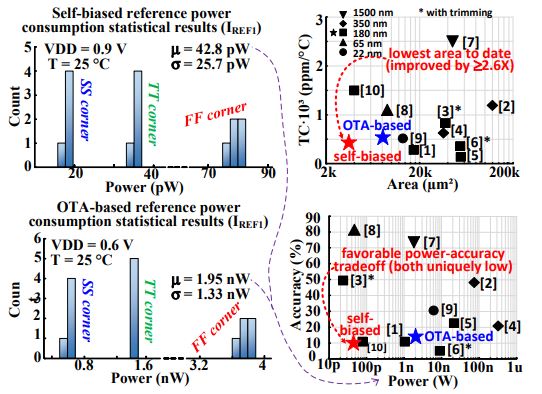
Current references are fundamental building blocks in sensor interfaces and other analog circuitries [1]–[9]. In applications with low-cost targets, their area and testing effort need to be minimized, and trimming must be eliminated. In power-constrained systems, their net power (i.e., not going into their output bias current IREF) and minimum supply voltage Vmin need to be kept low, so as to minimize the power burden and remove supply scaling limitations at the system level. Unfortunately, lower net power generally leads to poorer accuracy due to PVT variations, requiring innovation to make the power-accuracy tradeoff more favorable while avoiding trimming.
An L-band antenna array with eight elements and full digital beamforming using the Xilinx RFSoC is presented. Details of the implementation in the hardware, high level synthesis, and the software are provided. Digital beamforming is at the element level without the need for phase shifters or true time delays.
Researcher/Author:
Peizhuo Yang, Gong Chen & Koen Mouthaan
Published in:
Conference: 2023 IEEE International Symposium On Antennas And Propagation (ISAP)
To download the paper, please proceed to:
http://dx.doi.org/10.1109/ISAP57493.2023.10389090
Reconfigurable Quad-polarization L-band Antenna October 30, 2023
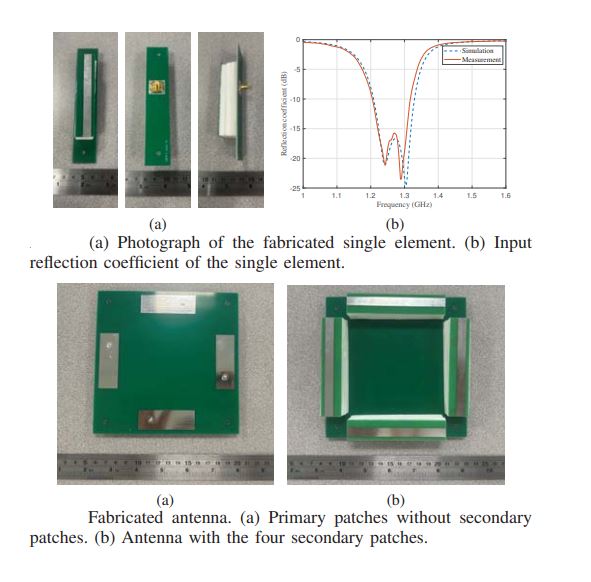
A low-cost L-band antenna with reconfigurable quad-polarization is presented. The antenna consists of four identical radiating elements. Each element comprises two stacked rectangular patches to achieve more than 10% bandwidth. Through proper phasing of the four elements, the antenna can realize two orthogonal linear polarizations and two circular polarizations. To demonstrate the concept, an antenna is realized using FR-4 substrate. The measured 10-dB input return loss bandwidth is 11%. And the measured 3-dB gain bandwidth is from 1.21 GHz to 1.36 GHz, with a maximum gain of 8.8 dBi for both linear polarization and circular polarization.
Researcher/Author:
Gong Chen, Fujiang Lin & Koen Mouthaan
Published in:
2023 IEEE International Symposium On Antennas And Propagation (ISAP)
Neelkamal SEMWAL received his Bachelor of Technology (B.Tech) from National Institute of Technology (NIT) Silchar, India in 2019.
He worked as a Senior Software Engineer at Ittiam Systems Pvt. Ltd., Bangalore, India from 2019 – 2022. He is currently working as a Research Engineer in the Green IC group. His research interest is on low power systems and circuits.
Karim received B.S. degree in electronics and communication engineering from Fayoum University, Fayoum, Egypt, in 2010, M.S. degree in electronics engineering from American University in Cairo (AUC), Cairo, Egypt, in 2013 and PhD degree in electrical and computer engineering from National University in Singapore (NUS), in 2019. He was a research assistant at Nile University from 2010 to 2011 and American University in Cairo (AUC) from 2011 to 2012. He was a graduate intern at PC client group (PCCG), Intel Cooperation, Oregon USA from 2012 to 2013. He worked as a teaching assistant at Middle East Technical University North Cyprus Campus (METU – NCC) in 2014. He is currently working as a research fellow at electrical and computer engineering department, NUS.
His research interest includes non-volatile memories and logic, computing in memory, low power ADCs, computer-aided design (CAD) for 3D ICs, and field programmable analog arrays IC design.